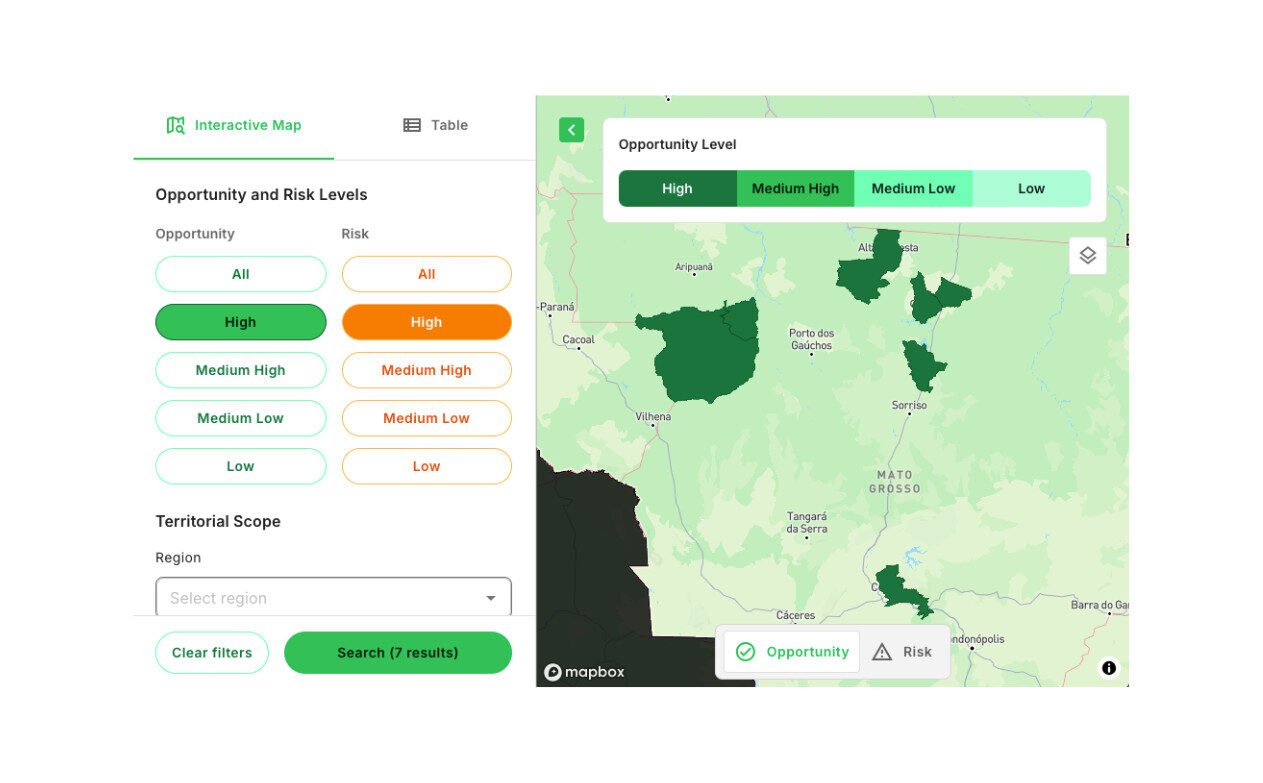
Entrepreneurs and investors in Nature-based Solutions (NbS) can use KYT-e to compare territorial risks and opportunities and select the municipality best aligned with their intended impact. In this use case, we demonstrate how location assessment should be conducted. Consider that the user is choosing between the municipalities of Tomé-Açu and Acará, both in Pará. They open the profile page for Tomé-Açu, add Acará in the “Compare municipalities” interface, and use this comparison to evaluate how these locations perform at the aggregate, dimension, and indicator levels; this information also helps to highlight aspects that should be prioritized during due diligence and subsequent field visits.
Looking at the radar charts, they note that Tomé-Açu is better positioned in the overall opportunity assessment than Acará, but it also has a higher risk profile across several dimensions. This result indicates that Tomé-Açu might be more appealing to SbN while simultaneously demanding a more careful approach to risk management. This is a common condition in the Amazon context: areas with high opportunity often coincide with greater pressure and complexity.
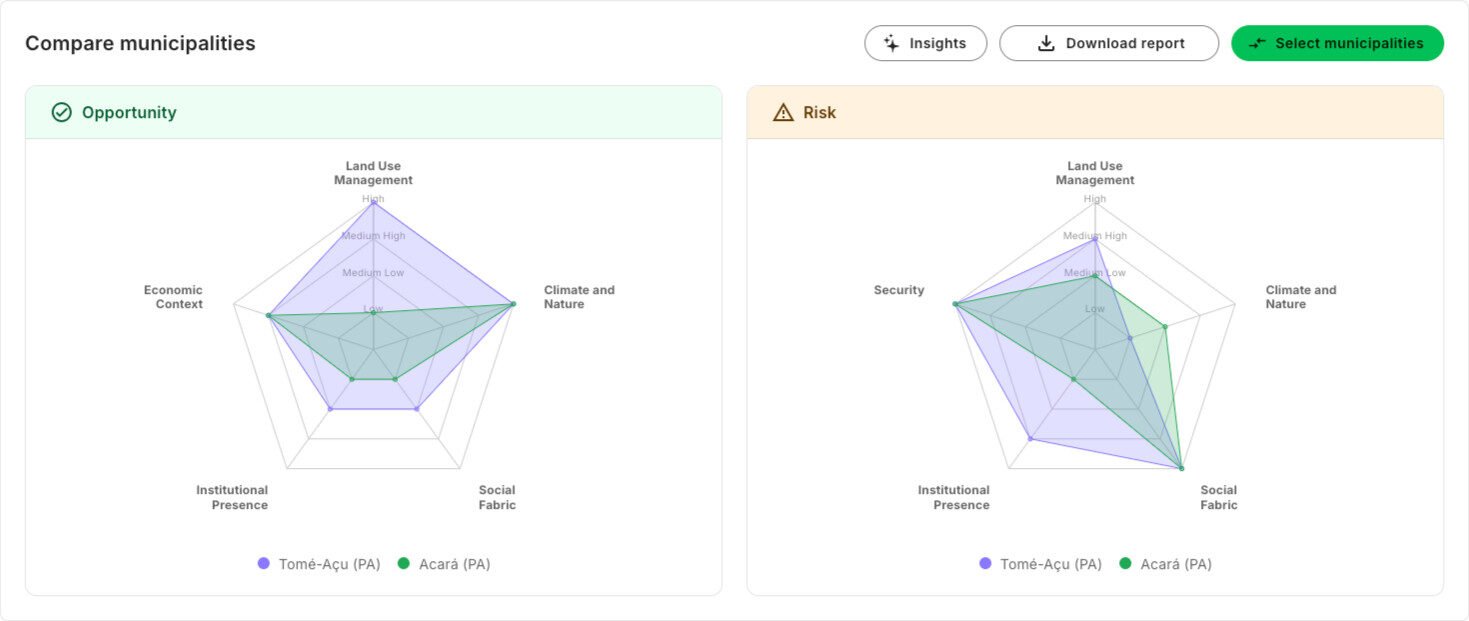
In the Land Use Management dimension, both municipalities are below the Pará state average for Opportunity, but Tomé-Açu surpasses Acará in most of these indicators. The municipality has more surplus natural vegetation, greater progress in the analysis or cancellation of private rural properties registered in the Rural Environmental Registry,1 and a larger portion of its territory covered by native vegetation. This combination suggests a more solid foundation for conservation, restoration, agroforestry, and other NbS models that depend on healthy ecosystems, indicating that the municipality has better land use management. At the same time, Tomé-Açu shows larger legal reserve deficits, a greater proportion of the municipality occupied by pasture, more IBAMA embargoes and infraction notices, as well as higher total and recent deforestation. This indicates an active dynamic of land use change and legal non-compliance regarding environmental aspects, potentially impacting reputation, which requires an in-depth investigation into how these dynamics might affect the user’s venture.
Acará, on the other hand, shows better performance in deforestation and enforcement indicators, but exhibits greater overlap between private rural properties and protected areas, as well as with rural settlements. This points to more complex land governance and potentially sensitive relationships with indigenous lands, conservation units, quilombola communities, and settlement projects. For NbS practitioners, this signals the need for more thorough due diligence around land tenure.

In the Climate and Nature dimension, both municipalities show similar levels of opportunity (above the state average), indicating that their environmental characteristics are highly favorable for NbS. However, Acará presents a slightly higher climate risk than both Tomé-Açu and the state average due to a more pronounced deviation in the number of extreme rainfall days in 2023 compared to its recent five-year trend. This suggests greater exposure to climate variability and extreme events, which has implications for agricultural stability and the resilience of NbS business models. Since Tomé-Açu appears less exposed to this indicator, operational planning becomes slightly more predictable.
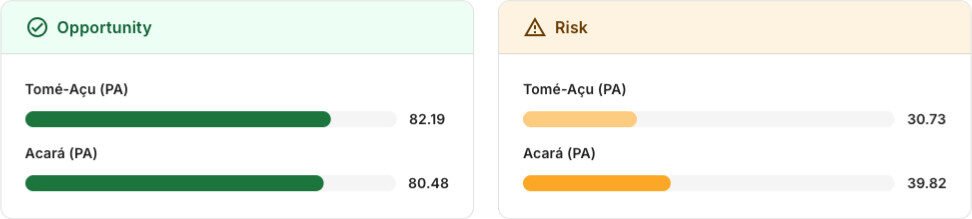
In the Economic Context dimension, both municipalities present similar opportunity profiles, higher than the state average. Neither offers a clear economic advantage at the macro level of analysis via the KYT-e platform, which indicates that economic factors should be refined at a more granular level during field visits.
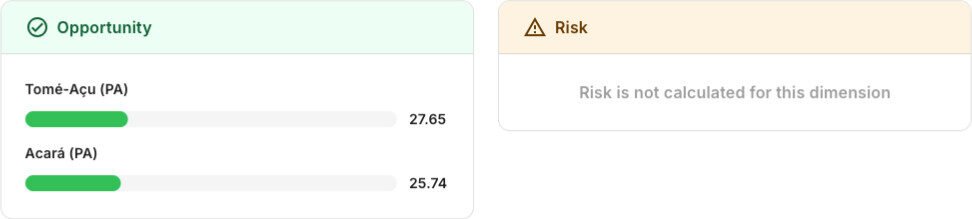
In the Social Fabric dimension, Tomé-Açu stands out positively, and surpasses the state average for Opportunity. It has a more active ecosystem of social rights advocacy organizations, higher vaccine coverage, and better access to mobile networks such as 4G and 5G. These features suggest stronger local capacity for organization, communication, and partnership, all of which facilitate the implementation and scaling of NbS. At the same time, Tomé-Açu shows higher social vulnerabilities than both Acará and the state average for Risk, including more workplace accidents and a higher number of children aged 0–5 with below-expected weight. This indicates underlying challenges in labor conditions and child health that responsible investors and entrepreneurs should take into account, for example by incorporating social safeguards and supporting complementary social initiatives.
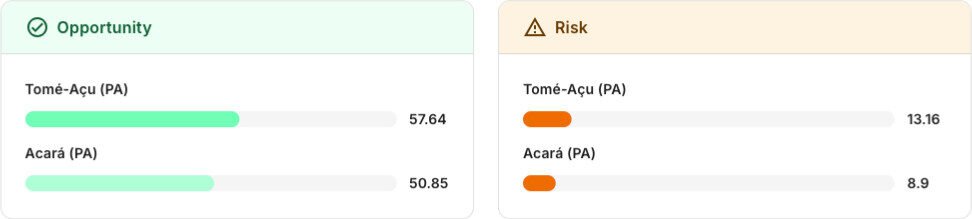
The Institutional Presence dimension is where Tomé-Açu clearly surpasses Acará and the state average, in terms of both opportunities and risks. Tomé-Açu has more healthcare facilities and professionals, scores better on management and accounting indices, and provides regular trash collection for a much larger share of households. However, the existence of disciplinary proceedings related to corruption, fraud, or obstruction, along with a higher rate of voter abstention, reveals vulnerabilities in municipal management and a lack of public trust in institutions. This chart suggests that the institutional environment in Tomé-Açu has more strengths and weaknesses than that of its neighbor, also because its risk level even surpasses the state average. Therefore, while there is institutional capacity to work with, the user would need to create a solid stakeholder map to ensure the integrity of their operations.
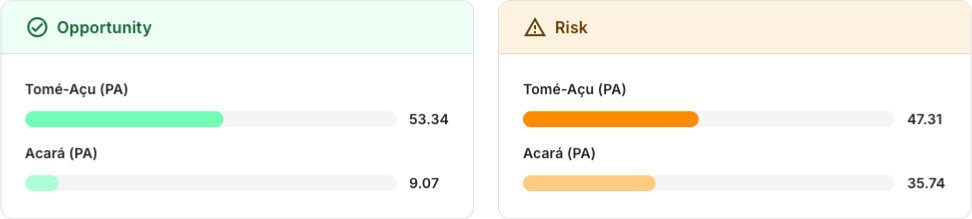
In terms of Security, Acará presents a higher level of risk than the state average, with a greater incidence of land and water conflicts than Tomé-Açu. This raises the probability of disputes affecting land use, access to resources, and project stability. Tomé-Açu appears relatively more stable in this regard, which can be an advantage for initiatives that require medium- to long-term agreements with landholders and communities.
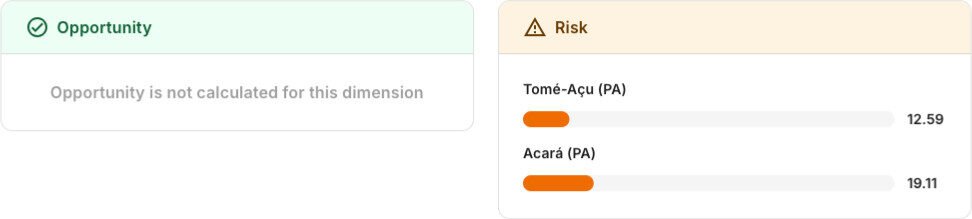
When the user brings together all the dimensions, a clearer picture emerges. Tomé-Açu combines stronger opportunities in land use, social fabric, and, especially, institutional presence, while simultaneously concentrating greater environmental pressure and certain institutional and social risks. The municipality resembles a territory of high opportunity and higher complexity, requiring a firm commitment to mitigating risks across a greater number of dimensions. Acará presents more modest opportunities overall, slightly higher climate and conflict risks, and more complex overlaps between private areas and protected or settlement territories.
From the interplay between these dimensions, the user can develop some systemic hypotheses. Tomé-Açu’s stronger institutional framework seems to fuel a more dynamic economy, but it also increases pressure on the environment. The municipality’s “machinery” runs smoother, offering the necessary logistics for agribusiness, which paradoxically accelerates land-use conversion and increases deforestation. Unlike Acará, where land tenure overlaps create structural gridlock and violent conflicts threaten to halt operations, Tomé-Açu’s features an economy that runs well and an organized civil society. For the investor, this signals that the local Social Fabric, although vulnerable on well-being indicators, possesses the networks and necessary capacity for articulation to implement improvements and create promising conditions for NbS projects.
Based on KYT-e, the user might decide to prioritize Tomé-Açu for investing in or implementing an NbS project, recognizing it as an operationally viable territory that still requires attention to the dimensions of Institutional Presence and Land Use Management. The platform not only helps identify Tomé-Açu as the most promising territory but also highlights which specific risks require attention. This makes it possible to structure due diligence and field visits around the indicators signaling the greatest vulnerability, design measures to address deforestation, land use pressures, corruption risks, and social vulnerabilities, and identify which institutions and organizations should be involved from the start. In this way, KYT-e functions as a strategic filter that guides where to focus and what to investigate, making territorial decisions for NbS in Brazil more informed, intentional, and transparent.
1 Cancellation is viewed as positive because it indicates that the self-reported records were evaluated and deemed inadequate according to current standards.