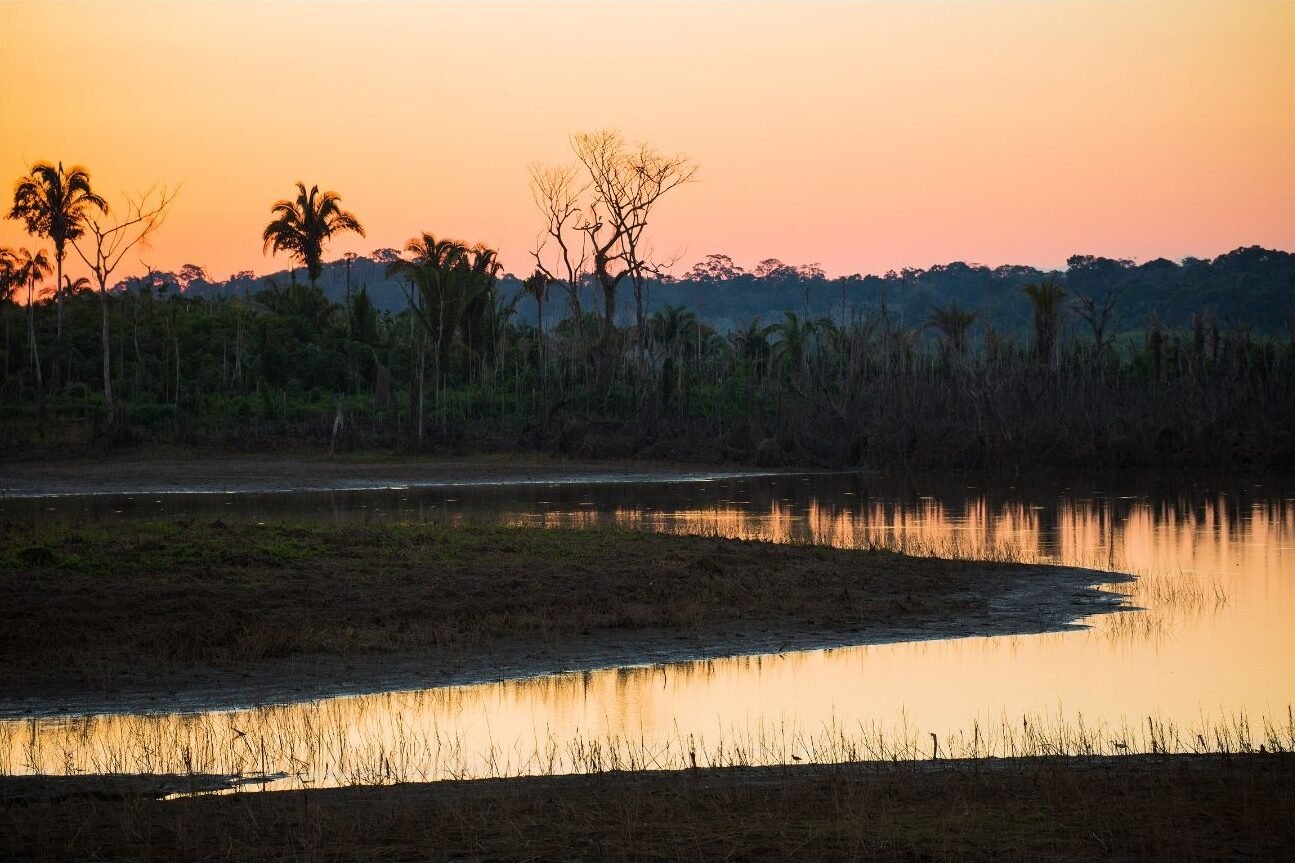
The Bom Futuro concession in Porto Velho (RO) proposes a new model for forest restoration, with carbon credits as the main revenue source. The bid foresees native restoration of about 15,000 hectares across 40 years, addressing an environmental liability created by irregular occupation and conflict. At the same time, the area lies in a region exposed to land grabbing, illegal logging, mining, cattle ranching, and explicit land conflicts, and it borders the Karitiana Indigenous Land. Any serious proposal for the concession will require a grounded view of territorial risk and opportunity that goes beyond the limits of the project area.
The KYT-e platform offers this perspective by allowing users to analyze territorial risk and opportunity both within and across municipalities. For the Bom Futuro area, a user might want to begin their analysis in Porto Velho, where Bom Futuro is situated, and then expand to include Candeias do Jamari, Alto Paraíso, and Buritis, which border or are close to the concession units.
In the Land Use Management tab, KYT‑e shows Porto Velho with lower risk than the state average and lower risk than the neighboring municipalities. Buritis appears more exposed in this dimension, having converted 58% of its forests to agriculture and with pastures covering 78% of its territory. This signals aggressive frontier expansion, leading to increased pressure from deforestation and fires that could easily spill over onto access roads and areas surrounding the concession. At the same time, Buritis still retains substantial natural vegetation, which points to ecological resilience and potential for conservation and sustainable use projects that could help mitigate indirect risks to Bom Futuro.
For Climate and Nature, Porto Velho combines high opportunity with the highest risk among the four municipalities. Indicators point to favorable restoration conditions: abundant rainfall, good soil water retention, and high carbon stocks in primary vegetation, which support large‑scale native restoration and carbon projects. However, the municipality also has a history of flood damage related to the Madeira River, including a state of emergency in April 2025, which could disrupt restoration work and impact the issuance of carbon credits.
The Economic Context dimension places Porto Velho in a decidedly stronger position than its neighbors. The data indicate substantial volumes of agricultural credit and purchases from family farming under the National School Feeding Program (PNAE), which can align with sustainable production and forest product supply chains. Porto Velho also boasts better logistics, including cargo terminals connected to the Madeira River, and a higher number of technical courses and formal workers compared to the smaller municipalities. For an NbS entrepreneur, this confirms that Porto Velho can serve as an economic and operational center for the concession, while still accounting for the surrounding socioenvironmental conditions.
In terms of Social Fabric, both Porto Velho and Buritis present considerable risks. The data indicate a relatively high number of forced labor cases in each location, which significantly raises the bar for labor compliance in any project seeking to avoid legal penalties and damage to its reputation. Porto Velho also has a high number of workplace accidents, warranting proactive measures for the Bom Futuro concession, including strict labor standards for contractors and suppliers, screening against forced labor, and strong investments in worker safety and training.
Institutional Presence shows more similar opportunity levels across the four municipalities. Porto Velho offers more public infrastructure in health and education but scores lower than its neighbors on the Decentralized Management Index, suggesting a weaker capacity to execute social policies. Buritis exhibits much higher electoral abstention than the state median, which may reflect distrust in public institutions. Porto Velho records many proceedings related to corruption, fraud, or obstruction. For a 40-year concession, this profile indicates the need to strengthen internal governance with clear anti-corruption rules, transparent engagement with public agencies, and rigorous internal controls for procurement, contracting, and investments in the local community.
Security is the dimension where Porto Velho registers its highest risk level, with an average of 171 intentional lethal violent crimes per year. In 2022, its homicide rate hit 47.6 per 100,000 inhabitants, compared to a median of 22.4 per 100,000 for Brazilian cities of a similar size. The neighboring municipalities show lower, though still significant, levels of violence. An operator considering a bid for the Bom Futuro concession can use this data to decide on security investments, establish protocols for staff and contractor safety, and coordinate efforts with authorities and local communities along the main routes to and from the concession area.
Taken together, the analysis using KYT-e indicates that Porto Velho has strong potential to support NbS thanks to its climate, ecological characteristics, and economic foundation, though it faces significant challenges related to security, the quality of its institutions, and social vulnerability. Neighboring municipalities add further pressure, particularly Buritis, with its comparatively high rates of deforestation and pasture expansion.
In this way, KYT-e gives entrepreneurs and investors an efficient, data-driven look at the trade-offs between risk and opportunity. For projects that need to look deeper than the municipal level, the Green Bridge Facility offers additional services like a Localized Territorial Risk Analysis, along with a Territorial Risk Management Plan that transforms the assessment into actionable steps.